Showing posts with label 科普. Show all posts

2011-11-15

太陽戴上PS裝甲


Image take by Prof. MCC, CUHK
'Processed' by LH with PS, after 15 minutes of learning

Needless to say, poorly process, good enough to impress laymen. And I would like to conclude that quite a large portion of amateur astrophotography ends with nice scopes and software. The rest of them depend on a correct time and place.

These are no longer astrophotos but astroarts.

Ref.
http://www.hapb.net/Solar/processing/photoshop.html
http://sungazer.net/ccdprocess.html

2011-09-27

衛星墜毀文字直播

1991年發射的Upper Atmospheric Research Satellite (UARS)為首個觀測大氣層的人造衛星,研究範圍包括化學成分,風速,以及太陽進入地球的輻射。NASA在2005年終止操作,將衛星棄置在軌道上,終於在上週六墜落大氣層。

向來都有留意太空事件的習慣,每日會查看遠在深空的信使帶來什麼。不過真正的現場直播還是第一次。

以下為當時的文字直播。


10:54 AM me: countdown... As of 10:30 p.m. EDT on Sept. 23, 2011, the orbit of UARS was 85 miles by 90 miles (135 km by 140 km). Re-entry is expected between 11:45 p.m. Friday, Sept. 23, and 12:45 a.m., Sept. 24, Eastern Daylight Time (3:45 a.m. to 4:45 a.m. GMT). During that time period, the satellite will be passing over Canada and Africa, as well as vast areas of the Pacific, Atlantic and Indian oceans. The risk to public safety is very remote.

18 minutes
11:12 AM georgeleung: sosad
11:13 AM 差唔多時候WO
 me: yes,留名睇高登仔阻擊衛星
11:14 AM georgeleung: 要金爺爺幫手adore
 me: no, he failed
  when the satellite drop, some civilians are killed
  高登仔可以徒手擋衛星
11:15 AM georgeleung: sosad 比金爺爺更勁o既高登仔

39 minutes
11:54 AM me: The likely re-entry window has opened. NASA predicts UARS will make its fiery plunge into the atmosphere within the next 60 minutes. The satellite is south of Australia at the current time, about to fly over the Pacific Ocean toward a crossing of Canada, then the Atlantic Ocean and Africa, if UARS remains in orbit that long.
11:55 AM georgeleung: sosad
  btw
 me: gogogo
11:56 AM georgeleung: 美國都有高登仔掛
 me: i think that is closer to layman than phd comics
11:58 AM georgeleung: PhD comics 除左學術撚之外邊個睇得明? sosad
11:59 AM me: right

10 minutes
12:09 PM me: 宜家有d似eva嗰集,等巨大太空使徒跌落嚟ge感覺 :o)
12:10 PM georgeleung: diu sosad
  你係花生友多d
 me: 我都冇睇過直播升空/墜毀
  ya等死嗰堆
12:11 PM georgeleung: Columbia 個次?
 me: 最接近ge係當年X-prize flight,SpaceShipOne連續兩次升空嗰陣中學一放lunch就去圖書館開機追
  超熱血沸騰
12:12 PM georgeleung: 幾時o既事?
 me: 2004, first private developed manned space mission (just sub-orbital)
12:13 PM georgeleung: 考緊會考sosad
  應該日日去左踢波sosad

24 minutes
12:38 PM me: 0430 GMT (12:30 a.m. EDT)
If UARS is still up there, it has passed over North America. We'll post official confirmation of the re-entry when it is announced.
  數已走
 georgeleung: sosad
12:42 PM me: 0434 GMT (12:34 a.m. EDT)
"It's possible that UARS is down by now," NASA just said. "We're waiting for confirmation from U.S. Strategic Command."
  it comes!
12:45 PM georgeleung: cant see shit
  O岩O岩出左去睇下
  咩都冇,,,除左木星
12:46 PM me: NASA says it has split into a couple dozen huge pieces and that it has slowed down on its descent toward earth.
  it is now above africa :o)
 georgeleung: :o)....

17 minutes
1:04 PM me: 0458 GMT (12:58 a.m. EDT)
NASA says the agency is working to confirm the re-entry location and time. It will provide an update shortly.
  rip
 georgeleung: sosad

2011-08-22

How I Killed Pluto and Why had it Coming – Michael Brown

In the good old days spending most of my pastime in the Astronomers’ Club (2000 - 2006), there are two celestial events which I found myself ‘getting involved’ to. The first one is the transit of Venus which has, like the Nightfall, never seen by any living person. The second one is the X-prize flights of SpaceShipOne. It is historical because, for the first time, space travel is made possible without politics and bureaucracy. The space is now open to everyone.

Recently, I started preparing presentation materials on Solar System for the third time. The first two trials are 11 and 5 years ago respectively, which means Jupiter has almost completed another orbit over such period of time. I found such figures scary that the pace of time is really unnoticeable, and it is both fortunate and unfortunate to see that I am still doing the same thing.

Unlike many other amateur astronomers, I pay a lot of attention to the science of Solar System, mainly because of the interest on geology and extraterrestrial stargazing. I found the edge of Solar System attractive because of the affection to ‘boundaries’ and ‘ends’. The blur images made these worlds even more mysterious. What you know is simply the fact that, under the beams of a very bright star, the dim red smooth surface remains un-intact for thousands of years. Only during the short while coming close to the bright star, bluish green fumes slowly engulf the planet and are quickly frozen after that. This is the world of slowness and darkness as if a speck of dust inside dark room, only seen when swept by a beam of light.

90377 Sedna, the outpost of Solar System
Does this image tell anything?

Of course I won’t mix up imagination and science. The edge of Solar System worth mentioning scientifically because objects there are very different from anything we know in the inner Solar System, and they provide important information on early Solar System. The most important of all is, the public know little about it. Therefore I decide to talk about it in details instead of repeating the features of other planets which the audience should have heard/read for several times.

During the research of material, I read Mike Brown's How I Killed Pluto and Why had it Coming. Brown is the most important observer of outer Solar System. Objects discovered include Sedna, Eris, Haumea, Makemake, Orcus and Quaoar. It is the best popular science literature I have read in terms of language. It also integrates research with the astronomer's personal life in great consistency.


I feel a bit regret for neglecting the prolific discoveries of the outer Solar System in the 2000s. During that period of time, the territory of Solar System increased by an order of magnitude. Now we know objects lying on the half way to the stars. I still remember I paid no attentions on the discovery of Quaoar and Eris because I had already held the belief that Pluto is just one of the Kuiper Belt Objects for years (noted in my lecture notes 2005). To me, discovering other KBOs simply completed the puzzle instead of being something really fascinating.

But actually it is entirely unscientific to neglect actual discoveries. It is discoveries which turn hypothesis into theories; huge number of reproduction of a particular discovery (which we call experiment and observation) turn theories into facts; while logical positivists regard this kind of facts as truth. This is why science is different from myths.

I am writing this to give tribute to observers who, through sky surveying, photometry, spectroscopy, keep building the universe. A world forms when a map of it is drawn. But on the other hand, infinitely many worlds perish at the moment the map is drawn. In this sense, astronomers are prophets of Brahman and Shiva.

2011-04-01

拍案驚奇之宇宙篇

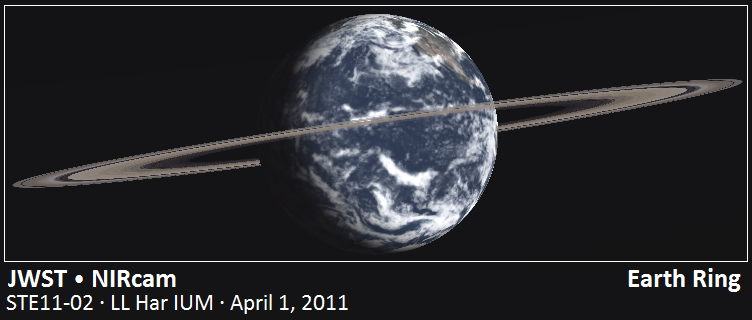
Elusive Ring of Earth Unveiled by JWST

The newly launched 2.4 billion dollar James-Webb Space Telescope (JWST) once again surprises the world in its first month of operation. This time it is something in our backyard. A ring around us.

"It is totally unpredictable," said C. Feldman, the chief scientist of the project. "All of us thought of the optical defects of Hubble's type at a first glance, but with cross checking we are convinced that there is nothing wrong with the instruments."

Earth has a large moon instead of two, it is common sense. Saturn has a spectacular ring while Earth has none, it is also common sense. But now JWST says NO. With the image taken by the Near Infrared Camera (NIRcam) as shown below, we now have a completely new picture of our home planet.

"We have limited visions," said Feldman, "which only covers a narrow range of electromagnetic spectrum". "We have to go IR for objects which are either too cold or covered by something cold, and that's why JWST works in this range".

JWST shows that the ring of Earth is made of carbon powders like those we find in cigarette butts, which reflects no light, and therefore invisible to human eyes. Hypothesis are proposed to recounstruct the way such amount of carbon managed to get there, its spread along the Earth-bound orbit.


地球軌道驚現光環 新型望遠鏡揭示看不見的宇宙

耗資達24億美元(約187.2億港元)的詹姆斯·韋伯望遠鏡(James-Webb Space Telescope, JWST)升空不足一個月已陸續帶來驚人消息。今次的發現不在宇宙深處,卻在我們每個人的頭上——地球上空掛著光環。

計劃的首席科學家費爾德曼指這是出乎意料之外的發現。「控制室內眾人不約而同想起哈勃望遠鏡的光學缺陷,但重重證據都顯示問題不在儀器之上。」

人人都知道地球有一顆衛星,沒有光環。隨著詹姆斯·韋伯望遠鏡的近紅外線攝影機(Near Infrared Camera, NIRcam)傳來最新的照片,我們對自己的行星將會有全新的認知。


「我們的視力很有限,只看到整個電磁波譜的一小部份。要看宇宙中溫度極低的區域,我們必須從紅外線著手。亦正因如此,詹姆斯·韋伯望遠鏡要在這一波段運作。」


分析指地球的光環主要成份是碳粉。由於碳粉完全不反射陽光,因此肉眼不會看到。目前科學家仍在提出假設,重組這些碳粉被灑落在地球軌道的過程。

2009-10-13

亂說化學

個人對化學主要的興趣在於分子模型的圖像. 一種種形狀各異的分子, 不論是畫在紙上, 還是能看到三維結構, 都不失為漂亮的圖形. 有點可惜的是, 無法花時間學懂這些了. 中學最後的幾個月, 稍為學了點organic synthesis, 對這種如下棋般環環相扣的"algorithm"頗感興趣. 但最後亦不了了之. Year 1倒在Inorganic chemistry下之後, 亦沒有再看名為"化學"的書.

感覺上不少物理系的同學對化學都沒甚麼好感, 確實是一件怪事. 一個想當然的答案是, 物理系的同學實在太討厭死記資料(資料而已, 聲稱沒有硬背過算式或算法大概都在騙人), 無法忍受週期表, 分子結構, 反應過程, 測試結果等無窮無盡的資料. 明明是一門與物理關係密切的學問, 沒興趣還算了, 但不認識卻不太健康. 當然, 這不是重點, 以下從略.

過度簡化之下, 從物理的角度看,

化學 = Schrödinger equation + 熱力學/統計力學 + 電磁學 + 經典力學
其中, 理論上
       Schrödinger equation =
物質[所有微觀(原子 + 分子) + 大部份巨觀]結構 + 所有化學反應
              
熱力學/統計力學 = 反應速率 + polymer + 溶劑特性
                             
電磁學 = 溶劑特性 + "雜質"在溶劑中的行為
                          
經典力學 = 少部份巨觀物質結構 + 其他 (例: optical isomer)

眾所週知, 即使在電腦的協助下, 這些理論上的"解決所有問題"沒有一個能完全實現. 而每次都從First Principle推導結果在任何一個學科都是不切實際的事. 由此看來, 所謂死記硬背的分別, 不過是程度上的分別. 物理人記住了計算的方法; 化學人記住了特例的結果. 唔. 看來也不是甚麼不可原諒的事.

感覺上物理與化學最大的分別是, 物理企圖找出最普遍的法則而化學專門研究特例. 物理法則怎樣追求"放諸四海皆準"是不用說的了. 化學的特例又怎麼說呢? 最明顯的當然是"水化學"和"碳化學"獨大的情況. 雖說研究的"潮流"經常改變, 但以水或碳為基礎的研究根本不可能會減退. 至於生物世界繁多的反應就更不用說了. 可能正是因為被研究的反應和份子實在太多, 因此在諾貝爾化學獎中, 實驗技術獲獎的比重較物理獎為高.

(
此段離題) 從某種意義上看, 化學比物理新. 此話怎說? 整個大學一, 二年級的物理課程中, 除了虛晃一下近代的固態理論和粒子物理外, 其餘的學問都有過百年歷史. 但高中程度的化學, 除了重覆一大堆十九世紀已完成的實驗外, 那些甚麼acid-base, Redox reaction的歷史都不過數十年. 雖說這不過是因為近代有關物質組成的研究才讓我們了解這些反應的機制, 較新是理所當然的. 無論如何, 兩門學問的性質相異, 這些討論也沒甚麼意義.

至於自己動手的實驗方面, 只能慚愧地說, 沒有甚麼有趣的作為. 隨著熟識的師弟逐一畢業, 以後該不會再有在實驗室胡作非為的機會了.

每次拿起一本厚厚的化學書, 打開, 很快便會頭昏眼花. 自是沒有基礎之故. 但還有一些不錯的科普書(這本, 這本和這本), 介紹近年化學的發展.

2009-04-04

The Physics of Mark 6

in response to MRC@Mark 6

Q: What is the physics behind the Mark 6 machine?
A:  Newtonian mechanics, i.e. F=ma and conservation of momentum.

Q: How are the initial conditions of each trail differ from each other?
A: Let's see some examples.
    六合彩 第129期
    六合彩 第  96期

   Obviously there is great difference in the position of blades of the windmill, and the way the balls fall.

Q: Can we conclude that Mark 6 is sensitive to initial conditions?
A: First we have to know what is mean by "sensitive to initial conditions". Let's think of several systems.
    1) A pencil rolling on the desk will eventually stop, no matter how you vary its initial speed
    2) 2 identical clocks are switched on at the same time, but with different initial settings in time. Although the time displayed on each clock is different, the difference in the time displayed is more or less the same.
    3) such thing would not happen if the velocity of the milk drop is slightly changed
          
Physicists only consider something like 3) as "sensitive to initial conditions", i.e. small difference in initial condition leads to great difference in final results. To measure this "sensitivity to initial conditions", it is assumed that final difference=initial difference*exp(constant*time). By repeating the experiment many times, we can get an average value of that constant. It is important to note that, since the experimental error of each trail is different, the value of constant of each trail is different and is NOT reproducible. Therefore we can only use the average value of the constant. If the average of constant>0, the we would say that the system is sensitive to initial conditions, or more simply, chaotic.

We can only judge if Mark 6 is chaotic by finding that constant, which can be obtained by tracking the positions and velocities of some balls. Maybe someone can do it by extracting these data from life broadcast of Mark 6.

Q: If we have perfect information on the initial conditions, is it possible to predict the result of each trail?
A: Yes, since the machine is completely deterministic. But the calculation will be terribly difficult.

Q: Is Mark 6 a biased game?
A: Yes. However this game is fair only if ALL balls have the SAME initial conditions, which is impossible. Why initial conditions manner is because they determines the initial velocity and the number of collisions with the "windmill". Similar games like roulette, and even slot machine (
老虎機) are biased.

To minimize the bias, the game setters then lengthen the "processing time" e.g. in Mark 6, some balls may collide n times, while the other collide n+m times, where n is much larger than m.

Q: Is there really a trend in Mark 6 results?
A: Maybe some numbers really appear more frequently, because of bias or just by chance. The number of possible combination of 7 balls within 49 balls is of course 49C7=85900584, while there are only several hundred sets of data available, we cannot judge whether there is any bias. However we can almost immediately conclude that, any attempt to analyse Mark 6 results with time series must fail, unless you believe that weather/planetary motion/spiritual power or other time dependent factors would affect the results.

Exercise
1. Suggest some practical ways to introduce more bias on Mark 6.

2007-12-26

追擊彗星二十日


在太陽系中,除八大行星外,有無數細小的石塊和冰塊(由雪櫃至青海的尺吋不等)繞太陽運行,分別稱為小行星和彗星。這些星體非常暗淡,一般都難以觀測。當彗星接近太陽時,表面的冰受熱化成氣體,亦會噴出大量冰粒和塵埃,反射陽光,因而變得越來越亮。以望遠鏡觀看彗星,便可看到彗核以及由噴出的氣體組成的彗髮和彗尾。

所有彗星都有巨大的彗尾。但由於彗星與地球的相對位置的關係,我們往往難以見到其彗尾。但最近一顆沒有壯觀彗尾的彗星亦為我們帶來驚喜。

在10月24日,休姆斯彗星17P/Holmes突然噴出大量氣體,亮度在24小時內暴增一百萬倍。25日晚收到消息後,幾位莊員和上莊便趕往牟Lib天台的鄧雁玲科學普及教育中心。在望遠鏡中可看到彗星明亮的核心和朦朧的彗髮,就如一對明暗分明的同心圓。雖說看不到彗尾,但一眾未看過彗星的莊員都相當「滿意」了。

既然明亮的彗星難得一見,此後幾日莊員們每晚都到MMW觀看這顆彗星。在26日看到的Holmes比較暗淡,影像較為「鬆散」。初時還以為是受煙霞影響,之後查看spaceweather.com才知道彗星的彗髮正在不斷膨脹,到了11月16日,體積已比太陽更大,暫時成為太陽系最巨大的成員(!?)。

由十月尾至十一月中多數時間都是烏雲密佈,大家唯有在網上追蹤彗星的動向。到了11月17日塔門觀星營,正當眾人萬念俱灰之際,雲層突然「放行」數小時,我們得以觀看比太陽更大的Holmes的尊容。這時在雙筒鏡中的彗星,就如一顆白茫茫的雪球,非常壯觀。此後Holmes的光度開始減弱。到了11月尾,如非事前知道彗星的位置也難以從雙筒鏡中辨認。

至今仍未有廣為接納的理論解釋為什麼Holmes會突然噴出大量氣體。一個主流說法為Holmes其實由兩顆彗星組成,當它們互相碰撞便會噴出氣體。

Holmes將於2014年再次接近地球。如想重溫一下Holmes今次回歸時的種種變化,可觀看http://en.wikipedia.org/wiki/17P/Holmes#2007_outburst,裡面有依時序排列的彗星相片。